
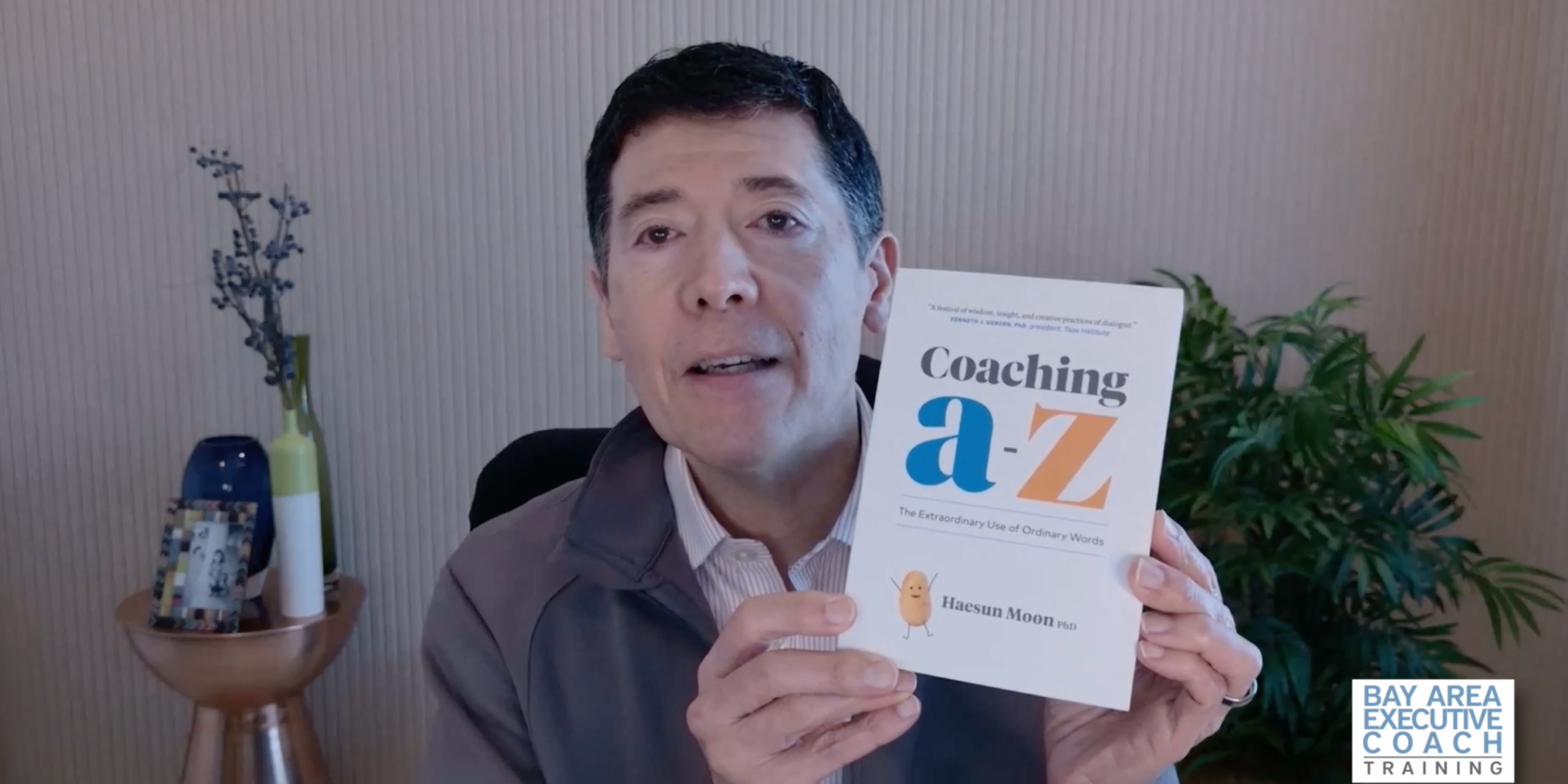
Haesun’s definition of coaching – Curating stories of purpose, possibilities and progress.
Throughout the book, she focuses more on what a client is doing well now and less on what they must do that’s lacking. Here’s a sample dialogue.
“I want to be a more effective leader.”
Instead of the coach saying “Okay, what’s not in your leadership approach that needs to be added?” and “How should you get there?”
The coach might ask, “Describe for me what was happening when you last felt effective?”
Or “When you feel like you’re an effective leader, what are you doing?”
See how that’s a different conversation? It’s about what are they doing well now and not what’s lacking in their leadership that needs to be fixed.
Haesun’s coaching sessions focus less on “What’s the matter” and more on “What matters?”
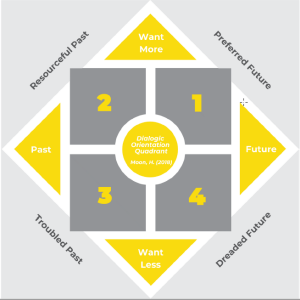
Haesun created the Dialogic Orientation Quadrant to help guide coaching conversations towards positive outcomes by focusing not on the Dreaded Future or Troubled Past, but instead on the Resourceful Past and Preferred Future. You can see it in this diagram, which was found in a slide deck that can be accessed here.
When you focus on what’s worked in the past and what’s already working now, the conversations are much more positive and supportive.
To get to what’s behind the motivations of someone to make a change, ask, “And what difference would that make?’ For example, “I want to stop giving my people the answers to their problems.”
You might say, “And what difference would that make?”
“It would empower them to start solving their own problems.”
You might say again, “And what difference would that make?”
“They would feel more confident and capable. And I’ll be freed up to focus on other things as they take care of things I previously had to attend to.”
You might say, “And what difference would that make?”
“I could then start increasing my strategic contributions to the organization, which I think I’m capable of doing. I want to show my stuff!”

And now we’ve gotten to what’s really motivating our client. Don’t just ask what’s the meaning behind the topic of wanting to do more to empower their people. You might fall short of the true motivation behind the topic by not digging deeper a few times with,
“And what difference would that make?”
Lastly, Haesun looks at scaling in a different way than most coaches do.
For one thing she focuses on a resource frame as opposed to a deficit frame. You see, most coaches will ask their client where they are on a scale of 1 – 10 with 10 being awesome and 1 being the opposite. The client will then say they’re at some number that’s typically less than 10.
What do you think most coaches will ask in response to their chosen number?
That’s right! Most coaches will ask the client what they can do to get to a 10. They see where the client is at now as a deficit.
Haesun sees the client as resourceful. What got them to where they are now? She might also ask if they’ve been at a higher level in the recent past. If so, what was that number? And what contributed to that? Lastly, she might ask what would they like to get to in the next period of their life. They might say a half a point, a full point or a few points higher. It’s their choice. You could then ask what would be good enough about getting to that new level.
See how different her approach is? It’s refreshing.
One thing to notice here is that her approaches to coaching conversations are all positive. Another theme is to get at deeper meaning (asking the And what difference would that make question. And lastly, it’s about feeling good about where we are and what we’ve already accomplished.
If my brief summary has intrigued you to learn more, I highly recommend getting her book for yourself. Each chapter is bite sized and easy to read. She weaves personal stories throughout, which are useful, too.
Get our monthly newsletter to receive relevant articles, resources, and news, as well as a complimentary eBook on 6 ways to get your first client, when you subscribe.
Here are other articles and videos you might enjoy:
Articles:
- 10 Great Books About Executive and Leadership Coaching
- Unlocking Leadership Potential: 10 Must-Read Books on Executive Coaching
- Did you read a book last year? 46% of Americans did not
- Learn one of my key marketing processes
- 5 Models for Leadership Coaching
- Have you tried audio only coaching?
YouTube Videos: